Review the system
We check photographs, opening hours, cooking type, previous reports and the extraction route.
Last updated:
Quick answer: 2026 and 2027 bring the biggest set of changes to ventilation in UK buildings for years. BESA’s TR19 Air standard for cleaning ventilation ductwork was updated in March 2026. A new edition of Approved Document F (Ventilation) applies to new homes in England from 24 March 2027. Awaab’s Law is putting strict timescales on landlords to deal with damp and mould, and the government is consulting on extending it to private renters. Behind all of it is one simple fact: we spend most of our lives indoors, and dirty, blocked or badly maintained ventilation makes the air we breathe worse. Keeping ductwork, fans and ventilation units clean is one of the most practical things a landlord, building manager or homeowner can do about it.
This guide explains what has changed, what is coming in 2027, what dirty ductwork means for breathing and health, and what you should actually do about it, whether you manage a block of flats, run a hostel, own a house with an MVHR unit or operate a commercial kitchen.
In his 2022 annual report on air pollution, the Chief Medical Officer for England pointed out that “over 80% of a typical adult day is spent indoors”, and that “indoor air pollution is becoming an increasing proportion of the problem as improvements in outdoor air pollution occur”. The report’s recommendations are blunt: “Ventilation and reducing emissions are important”, and “a better understanding of how we can prevent and reduce indoor air pollution should now be a priority”.
Indoor air carries moisture from cooking, showers and drying clothes, fumes from cooking, dust, fibres and anything brought in from outside. A ventilation system’s job is to remove that stale, damp air and replace it with fresh air. It can only do that if the extract vents, ducts, fans and filters are clear. When they are clogged with dust, fluff or grease, airflow drops, moisture stays in the building, and the system quietly stops doing the job it was designed for.
| Change | Date | Who it affects |
|---|---|---|
| TR19 Air Version 2 (BESA ventilation hygiene specification) | Published 3 March 2026 | Anyone specifying, cleaning or managing ventilation ductwork |
| Revised HHSRS operating guidance (housing hazards) | In force 23 June 2026 | Landlords and local authorities in England |
| Awaab’s Law phase 2 (social housing) | 30 November 2026, subject to parliamentary approval | Social landlords |
| Consultation on extending Awaab’s Law to private renters | Open until 18 December 2026 | Private landlords and letting agents |
| Approved Document F 2026 (Ventilation, Volume 1: Dwellings) | Takes effect 24 March 2027 (24 September 2027 for higher-risk building work) | New homes and building work in England |
| Awaab’s Law phase 3 (social housing) | 2027 | Social landlords |
| Private rented homes to reach EPC C | From 1 October 2030 | Private landlords in England and Wales |
| New Decent Homes Standard, including “free of damp and mould” | From 2035 | Social and private landlords |
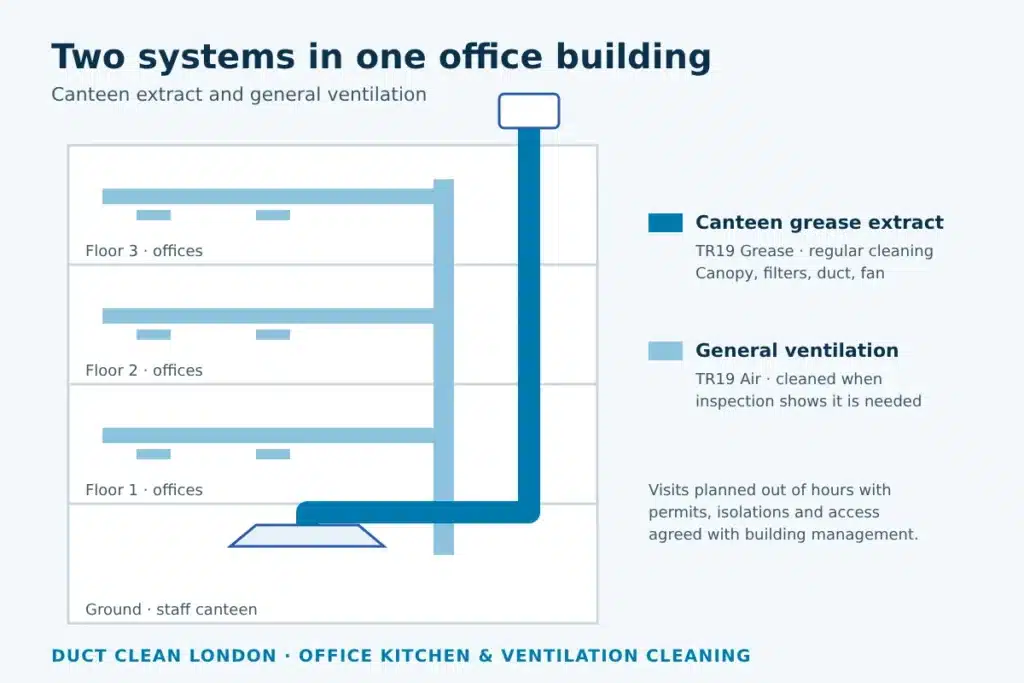
TR19 is the Building Engineering Services Association (BESA) guidance used across the UK for keeping ductwork clean. It is now split in two: TR19 Grease for kitchen extract systems, where the main concern is fire, and TR19 Air for general ventilation and air-conditioning ductwork, where the concern is hygiene and air quality.
BESA published Version 2 of TR19 Air on 3 March 2026, replacing the first edition from 2024. According to BESA, the update:
In practice, this means “we cleaned the ducts” is no longer good enough on its own. A proper service should leave you with evidence: what was inspected, what condition it was in, what was cleaned, and photographs before and after. If you are responsible for a building, that record is what you will be asked for by an insurer, an auditor or a tenant.
Approved Document F sets out how new homes in England must be ventilated. A new edition was published on 24 March 2026 alongside the Future Homes and Buildings Standards. It takes effect on 24 March 2027 for most building work, and on 24 September 2027 for higher-risk building work. Projects already submitted to building control before 24 March 2027 can follow the old rules, provided work starts before 24 March 2028.
Several of the changes are directly about keeping ventilation clean and serviceable:
The direction is clear: ventilation is now treated as a system that has to keep working for the life of the building, not something fitted and forgotten. Smooth, rigid ducts are easier to clean, and owners will be told in writing that cleaning and maintenance are part of looking after the home.
Awaab’s Law is named after Awaab Ishak, the two-year-old who died in 2020 after prolonged exposure to mould in his family’s social housing flat in Rochdale. It requires social landlords to investigate and fix certain hazards within fixed timescales.
For private landlords, the government opened a consultation on 9 October 2026, “Extending Awaab’s Law to private rented tenancies and to licences”, which closes at 11:59pm on 18 December 2026. No start date has been set yet; the consultation will shape when the new protections come in. Private landlords who act now will be ahead of whatever is decided.
The link to ventilation is direct. Government guidance on damp and mould says plainly that ventilation systems “should be regularly inspected and maintained by qualified professionals”, and that “it is totally unreasonable to blame damp and mould in the home on ‘lifestyle choices'”. If a bathroom or kitchen extract is blocked or barely pulling air, moisture stays in the home, and that is the landlord’s problem to fix.
The Housing Health and Safety Rating System (HHSRS) is how councils assess hazards in homes, including damp and mould. Revised regulations and new statutory operating guidance came into force on 23 June 2026, replacing guidance that dated back to 2006. Damp and mould remain one of the hazards councils can take enforcement action on.
Two longer-term changes are worth planning for now:
Energy upgrades such as new windows, insulation and draught-proofing make homes warmer but also more airtight. In a more airtight home, moisture and pollutants have fewer ways to escape, so working ventilation matters even more. Upgrading a property’s energy rating without checking that its extract fans and ventilation are clean and working is a common way to create a damp problem that was not there before.
A ventilation system does not create health problems on its own, but a neglected one stops removing the moisture and pollutants that do. The government’s guidance on the health risks of damp and mould, written with the UK Health Security Agency, lists effects including:
The same guidance says some people are at greater risk, including:
NICE guidance on indoor air quality at home (NG149) makes practical recommendations that only work if the ventilation itself is working. It advises using extractor fans in the kitchen and bathroom when cooking (especially on gas cookers), bathing, showering or drying clothes, and says tenants should contact their landlord if extractor fans are not working or trickle vents are blocked. It also recommends that landlords “develop and undertake maintenance programmes for heating and ventilation systems”.
To be honest about it: cleaning ductwork is not a cure for every breathing problem, and it will not fix a leaking roof or rising damp. What it does is make sure the extract and supply system is actually moving the amount of air it was designed to. You can read more in our honest guide, Does duct cleaning work?
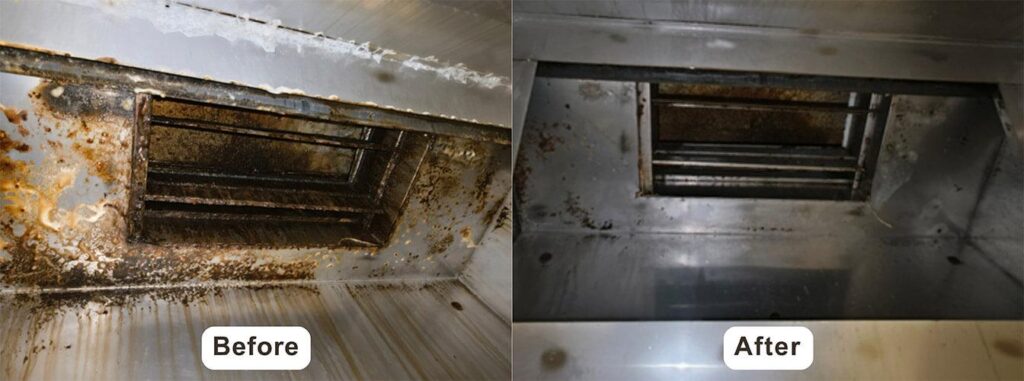
Depending on the building and how it is used, ducts, fans and vents collect:
The result is a fan that runs but barely moves air, a bathroom that stays steamy, a bedroom vent with a grey ring of dust around it, or an MVHR unit that is noisy and inefficient. For a fuller list of signs, see why air duct cleaning is important.
Kitchen extract systems follow TR19 Grease, which is about fire risk from grease build-up in canopies, ducts and fans. If that is you, see our guide to TR19 grease limits and our kitchen extraction cleaning checklist.
Dryer exhaust ducts collect lint, which is highly flammable. Shared ducts serving several machines need regular inspection and cleaning to keep airflow up and fire risk down.
You can see how this works step by step in how duct cleaning works.
There is no single law that says “clean your ducts every X months”. But landlords must deal with damp and mould and other hazards under the HHSRS, social landlords have fixed timescales under Awaab’s Law, and employers must provide adequate ventilation in workplaces. Keeping ventilation clean and working, with records, is how you show you have done that.
Not yet. It currently applies to social housing. The government is consulting until 18 December 2026 on extending it to private rented homes, and no start date has been set.
Not on its own. Mould needs moisture, so the cause has to be dealt with. If the cause is poor ventilation, getting extracts and ducts clean and working properly is an important part of the fix, alongside any repairs and treatment of affected surfaces.
Ask for the ventilation commissioning sheet and the operating and maintenance information, which should explain how and when the system should be cleaned and where the filters are.
It depends on the building, how it is used and what an inspection finds. TR19 Air takes a risk-based approach rather than one fixed interval. Kitchen extracts are different and are cleaned on a schedule linked to daily cooking hours under TR19 Grease.
Duct Clean London cleans ventilation and extract systems in homes, flats, hostels, laundries and commercial kitchens across London. Every job comes with before and after photos and a written report, so you have a clear record of what was done. To get a quote, use the chat on this page, send us photos of your vents and units, or visit our air duct cleaning service page.
Duct Clean London plans the accessible canopy, filters, ductwork, fan and discharge route as one connected system.
We check photographs, opening hours, cooking type, previous reports and the extraction route.
We identify access panels, high-level areas, risers, roof restrictions and safe working requirements.
Our engineers degrease the agreed accessible canopy, filters, ducts and fan components.
You receive post-clean photographs, a cleaning record and clear notes about limitations or follow-up.
Follow @ductcleanlondon for recent kitchen extraction and duct-cleaning videos.
@ductcleanlondon on TikTok
Explore the live map below. We mainly cover North West, West and Central London, including many locations within travel Zones 1–4. Send your full postcode so we can confirm access and availability.